Why Breath Smells Bad After Brushing: 6 Hidden Causes & Solutions
Brushed and flossed but your breath still smells? Discover why post-brushing odor occurs, the 6 anatomical reservoirs, and how to fix them.
Few oral hygiene frustrations equal spending two full minutes thoroughly brushing your teeth, only to exhale into your hand and discover your breath still smells stale, sour, or foul minutes later.
Breath smells bad immediately after brushing because toothbrushes only clean the hard enamel surfaces of your teeth - which account for barely 25% of the total surface area inside your mouth. The remaining 75% includes the posterior tongue dorsum, interdental contact points, subgingival pockets, and tonsillar crypts, where anaerobic bacteria continue releasing volatile sulfur compounds (VSCs) untouched by toothbrush bristles.
Key Takeaways: Why Post-Brushing Breath Stinks
- The Missing 75%: Tooth brushing only cleans teeth; it does not mechanically remove the dense bacterial paste coating the back third of the tongue.
- The SLS Drying Effect: Toothpastes containing Sodium Lauryl Sulfate (SLS) dehydrate oral mucosa, accelerating volatile sulfur gas release within 15 minutes of brushing.
- The Bacterial Vacuum: Cleaning your teeth without reseeding beneficial oral bacteria leaves an open ecological niche that fast-growing sulfur anaerobes quickly re-occupy.
- The Core Solution: Scrape the tongue with a metal scraper, floss interdental gaps before brushing, and melt an oral probiotic lozenge on the tongue to displace remaining anaerobes.
Problem → Cause → Fix: Post-Brushing Breath Matrix
| What Your Breath Smells Like | Anatomical Reservoir | Biological Cause | Proven Corrective Action |
|---|---|---|---|
| Rotten eggs / Sewage immediately after brushing | Posterior tongue dorsum | Dense coating of anaerobes fermenting mucous proteins | Scrape the back third of the tongue with a stainless steel U-scraper. |
| Decaying meat / Fecal odor | Interdental contact areas | Trapped food fibers and plaque decomposing between molars | Floss thoroughly before brushing using the C-shape technique. |
| Sour, metallic, or chemical taste | Mucosal tissues & salivary glands | Toothpaste with Sodium Lauryl Sulfate (SLS) stripping saliva | Switch immediately to an SLS-free, enzyme-supporting toothpaste. |
| Foul odor when exhaling through nose or throat | Tonsillar crypts | Calcified tonsil stones (tonsilloliths) harboring sulfur clusters | Gargle warm salt water; use oral probiotic lozenges to rebalance the oropharynx. |
| Musty, stale odor 20 minutes later | Dry oral cavity | Alcohol-based mouthwash or mouth-breathing drying saliva | Eliminate alcohol mouthwash; hydrate with water and chew xylitol gum. |
The 6 Hidden Reservoirs Toothbrushes Miss
1. The Posterior Tongue Biofilm (The Primary Reservoir)
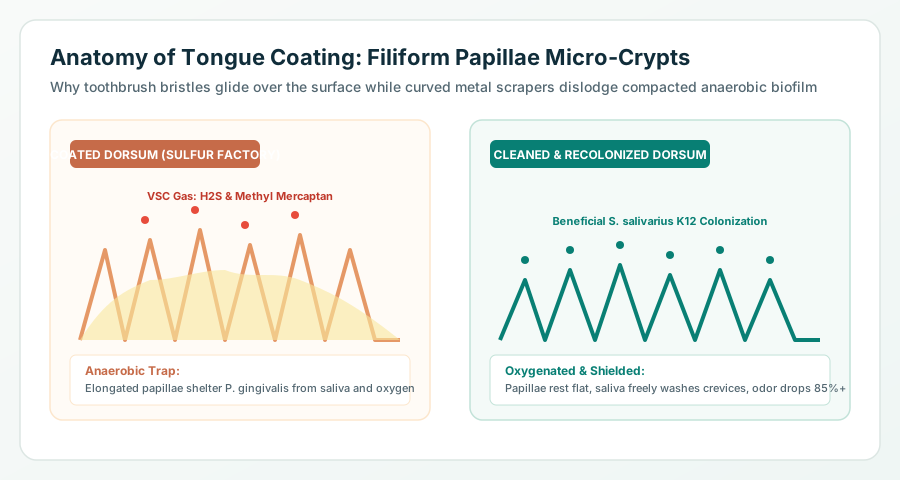
The back third of your tongue is carpeted with microscopic filiform papillae that trap food debris, dead white blood cells, and sulfur-producing bacteria. Because toothbrush bristles flex and flatten on contact, brushing your tongue simply smears this bacterial paste around rather than removing it. Using a rigid stainless steel tongue scraper lifts this biofilm cleanly in seconds.
2. Undisturbed Interdental Plaque
Toothbrush bristles cannot penetrate the tight contact areas between adjacent teeth. If you brush without flossing, you leave roughly 40% of plaque behind. This anaerobic plaque continuously putrefies, venting foul sulfur gases directly into your breath stream even when enamel surfaces are spotless.
3. Cryptic Tonsil Stones (Tonsilloliths)
Food particles and dead cells lodge inside deep tonsillar crypts, calcifying into pungent yellowish nuggets. Even with clean teeth and gums, exhaled air flows past your tonsils, picking up concentrated hydrogen sulfide and carrying it out of your mouth.
4. Harsh Detergents in Toothpaste (Sodium Lauryl Sulfate)
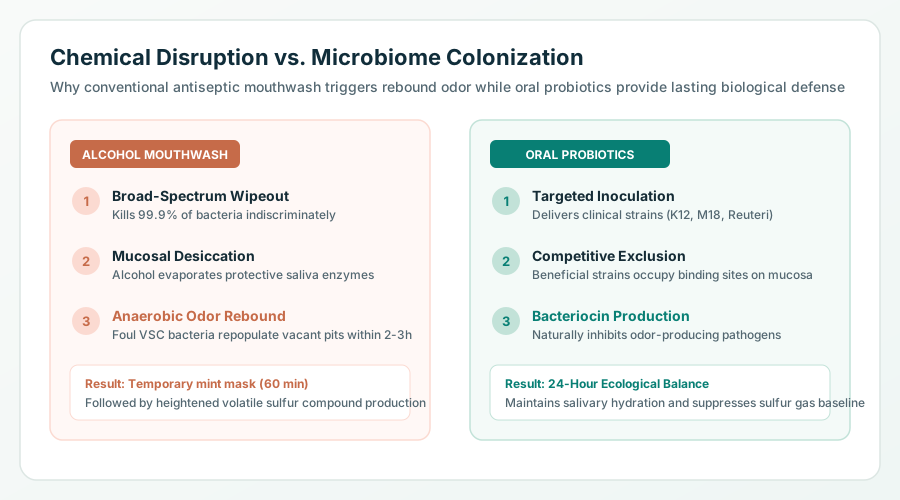
Many popular toothpastes use Sodium Lauryl Sulfate (SLS) to generate foamy suds, but SLS strips protective oral mucins and dries mucosal tissues. In sensitive individuals, this rapid desiccation reduces salivary buffering, triggering an immediate rebound of anaerobic bacteria within minutes of rinsing.
5. Periodontal Pockets Deeper Than 3 Millimeters
Plaque-induced gingivitis creates microscopic subgingival pockets between your teeth and gumlines. While toothbrush bristles reach approximately 1 to 2 millimeters beneath the gum margin, periodontal pockets can extend 4 to 7 millimeters deep, housing anaerobic bacteria that release continuous sulfur byproducts.
6. Chronic Xerostomia (Low Salivary Flow)
Saliva contains natural antibacterial enzymes like lysozyme, lactoferrin, and bicarbonate buffers that neutralize odors. If you are mildly dehydrated, take prescription medications, or breathe through your mouth, your saliva flow drops, allowing sulfur gases to evaporate rapidly into exhaled air.
Real-World Scenarios: How Readers Fixed Post-Brushing Breath
Scenario 1: The “Toothbrush Tongue” Misconception
- Situation: A 28-year-old brushed their teeth and scrubbed their tongue with their toothbrush twice daily, yet still had noticeable breath odor 15 minutes after brushing.
- Action: They switched to an inexpensive stainless steel tongue scraper and stopped using alcohol-based mouthwash.
- Outcome: The first scrape removed a heavy layer of yellowish paste that toothbrush bristles were missing. Within 3 days, post-brushing breath remained fresh for over 4 hours.
Scenario 2: The SLS Toothpaste Reaction
- Situation: A 45-year-old experienced a dry, burning sensation and sour breath within 20 minutes of brushing with a foaming whitening toothpaste.
- Action: They replaced their toothpaste with an SLS-free formula and began taking a nightly chewable oral probiotic lozenge.
- Outcome: Tissue irritation subsided within 48 hours, and natural saliva flow maintained fresh breath throughout the entire morning.
Decision Framework: What to Do Next
| Current Symptom / Habit | Primary Diagnostic Priority | Recommended Action |
|---|---|---|
| You do not scrape your tongue | Lingual papillae biofilm accumulation | Use a stainless steel U-scraper 3 to 4 times every morning. |
| Tongue is clean, but floss smells terrible | Interdental anaerobic putrefaction | Floss before brushing using the C-shape wrap technique daily. |
| Mouth feels parched 10 min after brushing | SLS chemical detergent desiccation | Switch immediately to an SLS-free, low-abrasion paste. |
| Odor persists despite scraping & flossing | Subgingival pockets or flora dysbiosis | Dental exam for periodontal pockets + bedtime oral probiotic lozenges. |
The 4-Step Routine for Permanent Fresh Breath
- Floss First: Clear interdental contact points so toothpaste can penetrate between teeth.
- Brush with SLS-Free Paste: Use a soft-bristled brush for 2 minutes to clean tooth enamel.
- Scrape Your Tongue: Use a metal scraper from back to front 3 to 4 times to lift the sulfur reservoir.
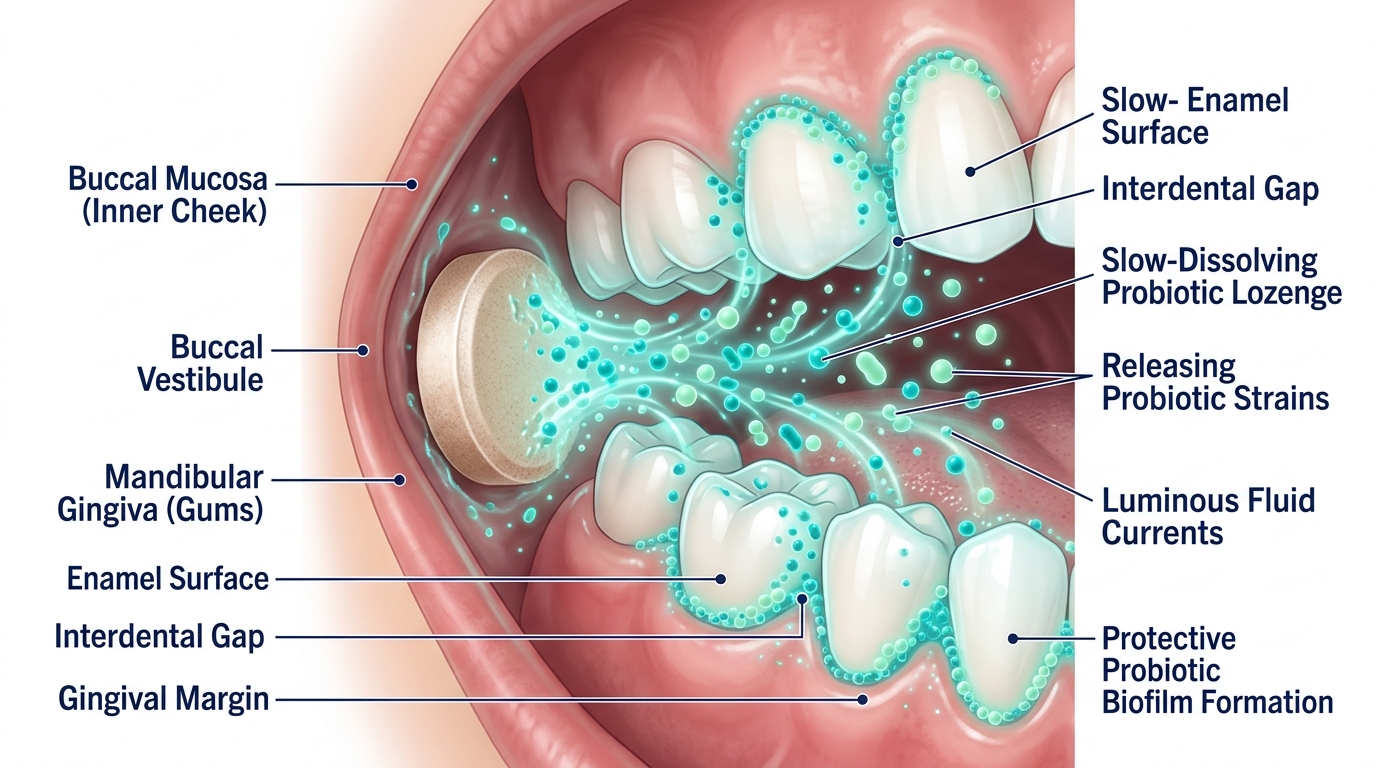
- Reseed with Oral Probiotics: Melt an oral probiotic lozenge slowly in your mouth before bed. This seeds beneficial Lactobacillus and Streptococcus species into the clean crevices, preventing odor-producing anaerobes from returning overnight.
Essential Dental Care Notice: oral concerns
Supplements and oral probiotics are exploratory adjuncts, not primary clinical treatments. They cannot reverse deep periodontal pockets, remove calcified tartar, or cure active dental infections. If you experience persistent bleeding, severe bad breath lasting weeks, or oral pain, schedule an in-person evaluation with a licensed dental professional.
Scientific Sources & Evidence References
Our editorial desk validates medical statements using peer-reviewed dental literature, clinical trials, and clinical consensus guidelines.
- The tongue coating as a reservoir for oral pathogens and volatile sulfur compounds
- Diagnosis and treatment of halitosis
- Evaluation of the role of subgingival microbiota in oral malodor
Spot an error or outdated supplement fact? We prioritize scientific accuracy. Submit a correction or editorial feedback →